
Linda Hidalgo works with one of the most underserved patient populations in the country. As a Blood Borne Virus Clinical Nurse with Prison and Youth Detention Health Services at West Moreton Hospital and Health Service, she knows better than most what it means to deliver care in a setting where time, access, and trust are all in short supply.
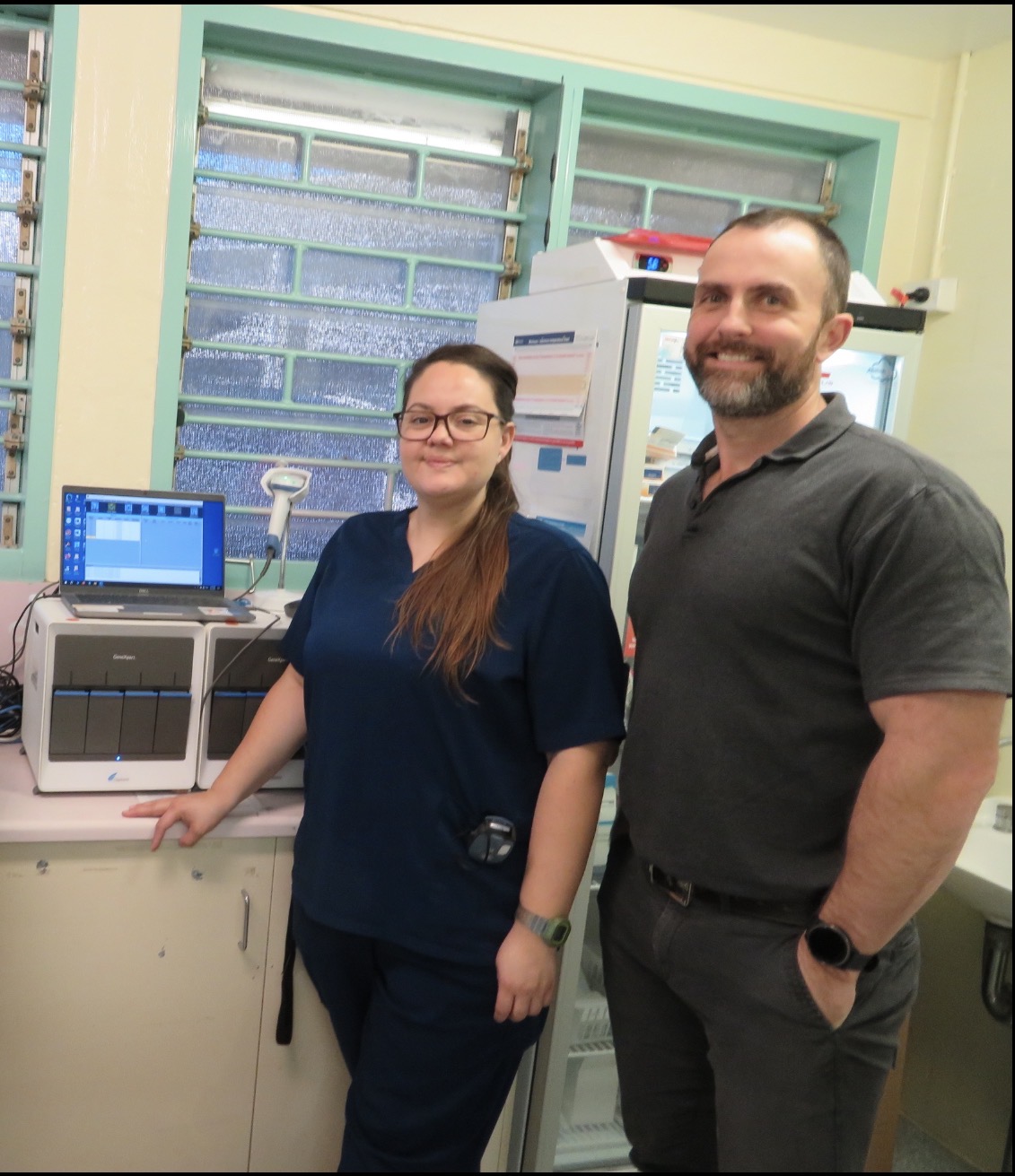
Caption: Linda Hidalgo and Chris Wallis with their GeneXpert machines at Prison and Youth Detention Health Services at West Moreton Hospital and Health Service
"My role allows me to lead with compassion, to meet people where they are, without judgment, and to empower them to take ownership of their health," she says. "For many, this is the first time they've felt genuinely listened to and supported. Being part of that moment never loses its impact."
For the people Linda cares for, Hep C Point-of-Care testing hasn't just been convenient, it's been transformative in the truest sense of the word.
Many of her patients carry the combined weight of stigma and the physical consequences of past injecting drug use, including poor venous access. Repeated failed attempts at blood collection can be traumatic enough that some people refuse testing altogether. The GeneXpert Point-of-Care HCV RNA test from fingerstick blood samples sidesteps that barrier entirely. "It's simple, minimally invasive, and fast," Linda explains. "In a custodial setting, timely care is critical." And fast really does mean fast, where traditional pathology testing for Hep C viral loads can take up to five days, GeneXpert confirms active infection from a fingerstick sample in under 60 minutes. In a setting where access to care is shaped by sentences, transfers, and system timelines, that difference is everything.
That speed is both logistically useful and clinically powerful. Earlier identification means faster links to treatment and reduced transmission risk within custodial facilities, outcomes that directly support the WHO elimination targets of a 90% reduction in new infections and a 65% reduction in Hep C-related mortality by 2030. Goals Linda clearly takes personally.
She's been part of the Australian Hep C Point-of-Care Testing program for around five years, and watching it grow has only deepened her commitment. But she's also picked up some hard-won practical wisdom along the way. "With GeneXpert testing, slow and steady really does matter," she says with the candour of someone who learned this firsthand. "Pushing the plunger too quickly into the cartridge can compromise the sample and the test." She's also learned to think about environmental factors. In colder weather, poor peripheral circulation can make finger-prick sampling tricky. Her tip? Ask patients to warm their hands under their armpits or rub them together while waiting. Simple, but effective.
For anyone just starting out with POCT, her advice cuts to the heart of why the technology matters: "See POCT not just as a test, but as an opportunity for meaningful clinical conversation. The immediacy of results creates space to discuss harm reduction, prevention, and ongoing health in a way that feels relevant and non-judgemental."
One surprising but essential piece of kit she'd never be without? The Fibro Scan. Heavy to transport, yes ("it definitely lets me know it"), but invaluable for quickly assessing liver health when APRI scores are high, or bloods are unavailable. A tool that’s helping the team make confident, timely decisions about the right care at the right time.
Linda shared that the Hep C testing setup at West Morton was established with Chris Wallis, Jacqueline Cuevas, and Laura Mitchell, with whom she shared an infectious kind of laughter, the kind that spreads before anyone can explain why. "One person starts, another snorts, someone struggles to keep a straight face, and before long we're all wiping tears." Staffing reshuffles have seen the team a little smaller now, with Linda and Chris Wallis, farewelling Jacqui and Laura earlier this year. Leaving Chris and Linda to continue the important work of the West Moreton BBV team. They bring clinical knowledge, generosity, and a willingness to advocate for better patient outcomes; often quietly, and without fanfare. "This work often happens behind the scenes," Linda says, "but it has a lasting impact on patient care, service delivery, and our broader health system."
For Linda, though, the technology is only part of the story. If she could make one problem disappear, it wouldn't be a disease or a policy failure; it would be the growing disconnection between people, the quiet desensitisation to human suffering that makes it easier to overlook homelessness, to judge people who inject drugs, or to reduce complex lives to labels. "When we restore human regard, compassion, curiosity, and dignity, many other issues begin to heal alongside it," she says.
Her personal hero, fittingly, is Desmond Doss, a WWII combat medic who ran unarmed into active battle zones again and again to save the wounded. "What inspires me most is not just his courage, but his moral clarity. He held firmly to his values in an environment that challenged them at every turn."
It's hard not to see the parallel.